
Middleware is the term for Node.js routines that execute within the request-response cycle. These functions process incoming requests before they reach the route handler or modify the outgoing response. Middleware is pivotal for adding features like authentication, logging, and data parsing, ensuring seamless communication between the client and server.
For example, middleware can:
- Execute custom logic.
- Modify request (req) and response (res) objects.
- End the request-response cycle or pass control to the next function.
Understanding Middleware in Node.js
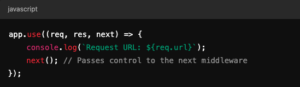
Middleware functions in Node.js interact with the req and res objects and typically include the next() method to control the flow. The next() function determines whether the next middleware in the stack should execute.
How Middleware Works
- Request Handling: Middleware can inspect, modify, or validate incoming data.
- Response Processing: Middleware customizes responses before sending them to clients.
- Control Flow: Middleware functions execute sequentially, forming a processing chain.
Example:
Types of Middleware
a. Built-in Middleware
Node.js and Express offer built-in middleware like express.json() for parsing JSON payloads.
Example:

b. Third-Party Middleware
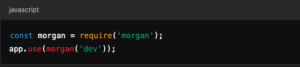
Popular packages like cors, morgan, and cookie-parser add enhanced functionality.
c. Custom Middleware
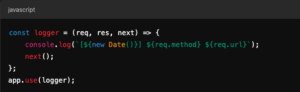
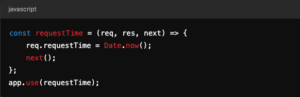
Developers can create middleware tailored to specific application needs, such as logging or validation.
Creating Custom Middleware
Custom middleware allows developers to implement unique features.
- Example 1: Logging Middleware
- Example 2: Request Timing Middleware
- Example 3: Cookie Validation Middleware
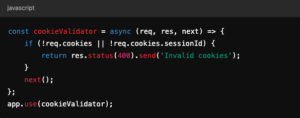
Middleware Error Handling
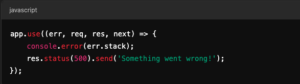
Error-handling middleware is vital for robust applications. If an error occurs, it can be passed to the error handler using next(error).
Example:
Middleware Configurability
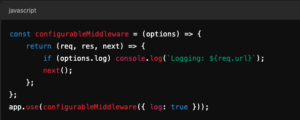
Middleware can be parameterized to allow flexible behaviour. By creating a factory function, middleware can adapt based on provided options.
Example:
Best Practices
To maximize the efficiency of middleware in Node.js:
- Order Matters: Middleware executes in the order it’s defined. Place error handlers last.
- Use Specific Middleware: Avoid using app.use globally for performance reasons.
- Optimize Performance: Only apply middleware where necessary to reduce overhead.
- Handle Errors Gracefully: Use centralized error-handling middleware.
Conclusion
Middleware is the start of Node.js development, which makes it possible to utilise reusable code without complexity. By comprehending how it works and utilising built-in, third-party, and custom middleware, developers can have scalable and efficient applications. Adhering to best practices, the request-response cycle will go out smoothly, which, in turn, will benefit both development and the end-user.
FAQs
Q1. What is middleware in Node.js?
Middleware functions process requests and responses in the application lifecycle, adding features like authentication or logging.
Q2. How does next() work in middleware?
The next() function passes control to the next middleware in the stack or ends the cycle if no middleware remains.
Q3. Can middleware modify the response object?
Yes, middleware can modify the response (res) object before sending it back to the client.
Q4. What are some common third-party middleware packages?
Popular packages include cors for cross-origin requests, morgan for logging, and body-parser for parsing request bodies.
Q5. How much time does middleware add to a request?
Middleware adds minimal latency, but optimizing middleware placement ensures high performance.
Need expert help? Learn more about Element8’s UI/UX design services in Dubai.