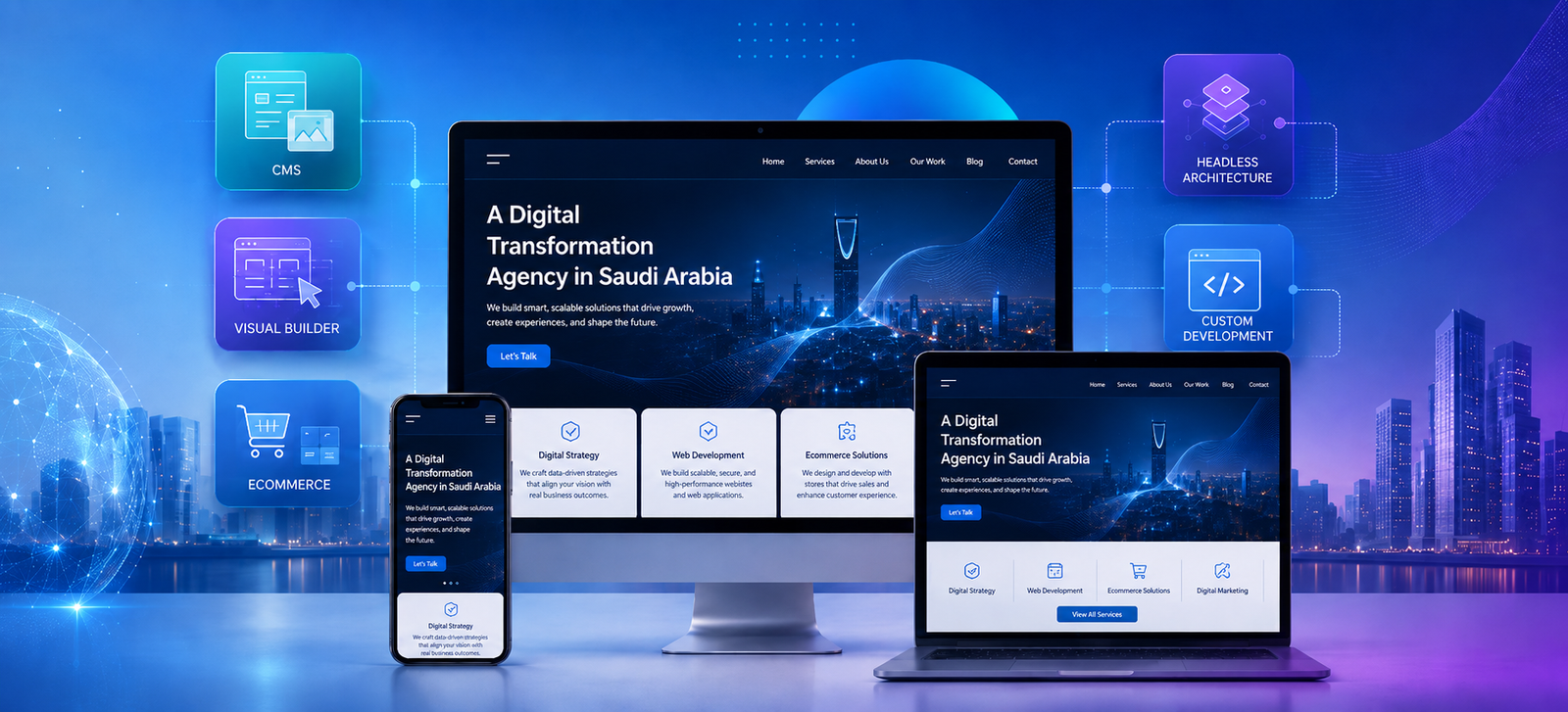
For businesses in Saudi Arabia, the decision can be even more important. Websites frequently need to support Arabic and English content, right-to-left and left-to-right layouts, mobile-first user journeys, local integrations, enterprise systems, and increasingly complex digital experiences.
There is no single best platform for responsive websites for every organization.
WordPress may be ideal for a content-driven corporate website. Webflow may be better for a design-led marketing site. Shopify makes more sense when commerce is the core requirement. Larger organizations may need a headless CMS or completely custom architecture.
The right choice depends on the website’s purpose, content model, internal team, integrations, performance requirements, security needs, and long-term growth plans.
This guide compares the leading approaches to help businesses choose the right responsive website platform in 2026.
What Is a Responsive Website Platform?
A responsive website platform is the CMS, commerce system, development framework, or technology stack used to create a website that adapts effectively across different screen sizes and devices.
Responsive design normally uses flexible layouts, responsive images, modern CSS techniques, and breakpoints to ensure content remains usable whether someone is accessing the site from a smartphone, tablet, laptop, desktop monitor, or another connected screen.
Google recommends responsive web design because the same URL and HTML can be used across different devices while the presentation adapts according to screen size.
However, simply choosing a platform that supports responsive layouts does not guarantee a good mobile experience.
A responsive website should provide:
- clear navigation on smaller screens
- readable content without unnecessary zooming
- properly sized buttons and interactive elements
- responsive images and media
- fast loading performance
- stable layouts
- accessible forms
- consistent functionality across devices
- well-designed Arabic and English experiences where required
The platform should make these requirements easier to achieve rather than becoming an obstacle.
What Makes a Good Platform for Responsive Web Development?
Before comparing platforms, businesses should look beyond templates and visual appearance.
A strong website development platform should support the entire website lifecycle.
1. Responsive Design Flexibility
Designers and developers should be able to control layouts, typography, images, navigation, grids, and content hierarchy across different viewport sizes.
2. Performance
The platform should allow developers to optimize:
- images
- JavaScript
- CSS
- fonts
- caching
- content delivery
- server response times
Google’s Core Web Vitals measure aspects of real-world loading performance, interactivity, and visual stability, making technical performance an important consideration when evaluating website architecture.
3. SEO Control
Businesses should have control over:
- title tags
- meta descriptions
- canonical tags
- redirects
- structured data
- XML sitemaps
- robots directives
- image alt text
- heading structure
- hreflang implementation
- crawlability
4. Content Management
Marketing teams should be able to update routine content without needing a developer every time a page, article, case study, service, or campaign needs to change.
5. Arabic and Multilingual Support
For Saudi businesses, multilingual architecture should be considered from the beginning rather than added after launch.
The platform should support Arabic RTL layouts, English LTR layouts, localized URLs, translated metadata, hreflang, and independent content management where required.
6. Integrations
Modern corporate websites may need to connect with:
- CRM platforms
- ERP systems
- marketing automation platforms
- payment gateways
- analytics tools
- customer portals
- booking engines
- HR systems
- APIs
- identity platforms
7. Security and Governance
Larger organizations may also require approval workflows, user permissions, auditability, deployment controls, and clearly defined maintenance responsibilities.
8. Scalability
A platform that works for a 20-page website may not be appropriate when the business eventually needs 5,000 pages, several languages, multiple business units, personalization, and numerous API integrations.
That is why platform selection should consider the next three to five years rather than only launch day.
WordPress
WordPress remains one of the most practical platforms for responsive corporate websites because it combines flexible content management with an extensive development ecosystem.
Element8 itself continues to use WordPress for content-driven website implementations, while more advanced enterprise requirements can also be addressed through WordPress VIP or headless WordPress architectures.
Why WordPress Works Well
WordPress provides considerable flexibility for both editors and developers.
Key advantages include:
- flexible content management
- strong blogging and publishing capabilities
- extensive integration options
- granular SEO control
- custom post types and structured content
- large ecosystem of development tools
- support for multilingual implementations
- ability to create completely custom responsive designs
A professionally developed WordPress website does not need to look like a template.
An experienced development team can create a custom design system while allowing marketing teams to manage structured content through the CMS.
Best For
WordPress is particularly suitable for:
- corporate websites
- service-based businesses
- B2B companies
- content-heavy websites
- publishers
- professional services firms
- organizations investing heavily in SEO
- businesses that publish frequently
Limitations
WordPress can become problematic when poorly implemented.
Typical risks include:
- excessive plugins
- page-builder dependency
- unnecessary JavaScript
- inconsistent component design
- outdated plugins
- weak hosting
- inadequate security processes
The platform itself is rarely the primary problem. Architecture, development quality, hosting, governance, and maintenance usually determine whether a WordPress website remains fast and manageable.
Webflow
Webflow has become a strong option for companies that prioritize visual design, relatively fast production, and marketing-team independence.
Its visual development environment allows teams to build sophisticated responsive layouts while retaining considerably more design control than conventional template builders.
Webflow has also continued expanding its CMS architecture and localization capabilities. Its current localization tools allow teams to customize content, styles, assets, visibility, and page settings for different locales.
Why Webflow Works Well
Key advantages include:
- strong visual design control
- responsive breakpoint management
- integrated hosting
- fast iteration
- CMS capabilities
- reusable components
- relatively straightforward marketing workflows
- built-in localization options
Webflow can be particularly effective when marketing and design teams need to launch and iterate campaigns without creating a large development dependency.
Best For
Webflow works particularly well for:
- marketing websites
- startups
- SaaS companies
- design-led brands
- campaign websites
- portfolio websites
- relatively structured corporate websites
Limitations
Despite improvements to its CMS, Webflow may still be less suitable when a project requires highly specialized backend functionality, unusual publishing workflows, complex enterprise integrations, or substantial custom application logic.
The decision therefore depends heavily on what the website is expected to become.
Headless CMS
A headless CMS separates content management from the front-end presentation layer.
Instead of the CMS controlling exactly how a webpage is rendered, structured content can be delivered through APIs to different front ends.
Those front ends could include:
- corporate websites
- mobile applications
- customer portals
- ecommerce experiences
- kiosks
- digital displays
- AI interfaces
- other connected platforms
This architecture has become increasingly relevant for organizations building larger digital ecosystems.
Why Headless CMS Works Well
A headless architecture can provide:
- greater front-end flexibility
- structured content
- multi-channel publishing
- independent front-end development
- scalable API-driven architecture
- improved integration flexibility
- reusable content across multiple experiences
Platforms such as Strapi can provide centralized content governance while allowing organizations to distribute content across different digital systems.
Best For
Headless CMS is particularly appropriate for:
- enterprise organizations
- large publishers
- multi-brand groups
- organizations running websites and apps
- multilingual digital ecosystems
- companies requiring significant system integrations
- businesses expecting substantial future expansion
Limitations
Headless does not automatically make a website faster or better.
It introduces additional architectural complexity.
Organizations may need:
- stronger development capabilities
- DevOps resources
- front-end frameworks
- API management
- preview workflows
- separate hosting infrastructure
- more sophisticated governance
A simple corporate website rarely needs headless architecture purely because it is considered modern.
Shopify
Shopify should be considered differently from WordPress or Webflow because its primary purpose is commerce.
If the central business requirement is selling products online, Shopify provides a mature managed ecosystem covering storefronts, checkout, catalog management, apps, payments, promotions, and commerce operations.
Shopify’s official theme ecosystem includes responsive themes designed for different store types and catalog sizes.
Why Shopify Works Well
Advantages include:
- mature ecommerce functionality
- responsive storefront themes
- managed infrastructure
- product and inventory management
- checkout functionality
- extensive app ecosystem
- multi-channel commerce support
- relatively fast deployment
Best For
Shopify is suitable for:
- D2C brands
- retail businesses
- product businesses
- growing ecommerce companies
- businesses where transactions are the website’s primary purpose
Limitations
Shopify may be less appropriate for organizations where complex corporate content, unusual workflows, extensive publishing, or heavily customized backend functionality are more important than commerce.
Extensive customization can also increase reliance on apps and specialist Shopify development
Custom Website Development
Sometimes the right platform is not an off-the-shelf platform at all.
Custom website development allows businesses to build the front end, backend, workflows, integrations, and architecture around exact business requirements.
Modern custom builds may use technologies such as Next.js, React, APIs, cloud infrastructure, and custom backend systems.
Element8’s web development stack, for example, includes technologies such as WordPress, Umbraco, Sitecore, Next.js, and React depending on the requirements of the project.
Why Custom Development Works Well
Custom development provides:
- complete UX control
- custom business logic
- deep API integrations
- tailored architecture
- sophisticated user journeys
- custom portals
- role-based environments
- greater freedom over technical decisions
Best For
Custom development is usually best for:
- complex enterprise platforms
- customer portals
- marketplaces
- digital products
- membership systems
- large data-driven websites
- websites integrated deeply with internal systems
- unique operational workflows
Limitations
The flexibility comes with greater responsibility.
Custom development normally involves:
- higher initial investment
- longer planning and development cycles
- more detailed QA
- ongoing technical maintenance
- dependency on an experienced development team
Which Platform Is Best for SEO?
There is no CMS that receives an automatic Google ranking advantage simply because of its brand name.
SEO performance depends much more heavily on implementation.
A website needs:
- crawlable HTML
- sensible architecture
- fast performance
- mobile-friendly design
- indexable content
- clean internal linking
- metadata control
- structured data
- canonical management
- image optimization
- strong content
Google recommends responsive web design as a straightforward approach to supporting mobile users and mobile-first indexing.
From an SEO-control perspective, WordPress, Webflow, Shopify, headless CMS platforms, and custom builds can all perform strongly when implemented correctly.
The difference lies primarily in how much control the platform gives the development and SEO teams.
For large-scale SEO programs, platform architecture should be evaluated before development starts rather than attempting to repair technical limitations after launch.
Which Platform Is Best for Arabic and English Websites?
For businesses operating in Saudi Arabia, bilingual capability deserves more attention than it often receives during platform selection.
Arabic implementation is not simply a translation exercise.
Businesses need to consider:
- RTL interface design
- Arabic typography
- navigation behavior
- localized imagery
- content expansion and contraction
- Arabic URLs where appropriate
- localized metadata
- hreflang
- CMS workflows
- search functionality
- form layouts
WordPress, Webflow, headless platforms, and custom development can all support multilingual implementations.
Webflow now provides dedicated localization capabilities for content and locale-specific experiences, while headless systems can model Arabic and English content independently within structured content architectures.
For larger Saudi organizations, the more important question is therefore not simply “Does it support Arabic?”
It is:
“Can our teams manage Arabic and English experiences reliably at scale?”
What Enterprise Organizations Should Prioritize
Enterprise platform selection should be treated as an architecture decision rather than simply a website-design decision.
Larger organizations commonly need:
- multilingual publishing
- multiple departments or business units
- role-based permissions
- approval workflows
- structured content governance
- enterprise search
- API integrations
- CRM and ERP integration
- security controls
- scalable hosting
- analytics integrations
- technical SEO governance
- reliable staging and deployment processes
Enterprise websites may also function as gateways into operational systems rather than simply acting as marketing websites.
For these environments, organizations may need an enterprise CMS, headless architecture, composable technology stack, or custom development solution.
Element8’s enterprise web development services are built around these types of scalable, integration-heavy requirements.
Common Mistakes When Choosing a Website Platform
Choosing Based Only on Design
An impressive demo says very little about how easy the website will be to operate two years later.
Evaluate the CMS, integrations, workflows, SEO controls, and maintenance requirements as carefully as the visual capabilities.
Choosing the Cheapest Initial Option
A low-cost implementation can become expensive when teams later discover that every update requires development or that the website must be rebuilt to add essential functionality.
Consider total cost of ownership rather than launch cost alone.
Ignoring SEO Until Development Is Finished
SEO requirements can affect:
- information architecture
- JavaScript rendering
- URL structures
- taxonomy
- navigation
- templates
- redirects
- structured data
- multilingual architecture
SEO should therefore be included during platform and architecture planning.
Adding Arabic After the English Website Is Finished
For Saudi organizations, Arabic should form part of UX and content architecture from the beginning.
Retrofitting RTL support later often creates unnecessary design and development problems.
Using Too Many Plugins or Apps
WordPress plugins, Shopify apps, and third-party integrations can all add useful capabilities.
However, every additional dependency introduces potential performance, security, maintenance, or compatibility considerations.
Choosing Technology Based on Trends
“Headless”, “composable”, “AI-ready”, and “no-code” may all sound attractive.
None of them automatically makes a website better.
The technology should solve a defined business requirement.
How to Choose the Right Responsive Website Platform
Before selecting a platform, answer the following questions.
Content
- How many pages will the website contain?
- How frequently will content change?
- How many people will manage content?
- Will there be multiple languages?
- Do different departments require approval workflows?
Marketing and SEO
- Is organic search an important acquisition channel?
- Will landing pages be created frequently?
- Does the SEO team need advanced technical control?
- Will large volumes of content eventually be published?
Technology
- Does the website need CRM integration?
- Does it need ERP integration?
- Are custom APIs required?
- Will content also appear in apps or other channels?
- Is there complex business logic?
Commerce
- Are products being sold online?
- Is commerce the main purpose of the platform?
- Are complex product catalogs or marketplace functionality required?
Internal Resources
- Who manages the website after launch?
- Does the company have developers internally?
- Does the marketing team require independent page creation?
- Who handles security, updates, and hosting?
Growth
- What should the website be capable of doing three years from now?
- Will new markets, languages, business units, or products be added?
- Could the website evolve into a wider digital platform?
These questions normally make the platform decision much easier.
Choosing the Right Website Platform with Element8
A responsive website should do more than fit different screen sizes.
It should support the way your business markets, publishes, sells, integrates systems, serves customers, and grows.
That means platform selection should happen before detailed design and development begin.
At Element8, we design and develop responsive digital platforms for businesses in Saudi Arabia using technologies selected around the actual requirements of each project—not around a preferred template or trend.
Depending on the project, that may involve WordPress, enterprise CMS platforms, headless architecture, Next.js, React, or fully custom development.
Our approach considers:
- user experience
- responsive web design
- Arabic and English requirements
- CMS usability
- SEO
- Core Web Vitals
- security
- enterprise integrations
- performance
- scalability
- long-term maintenance
If you are planning a new corporate website, enterprise platform, or website redesign, start by defining what the platform needs to support today—and what the business will expect from it in the future.
Explore Element8’s website development services in Saudi Arabia or website design services to discuss the right architecture for your project.
Frequently Asked Questions
What is the best platform for responsive website design?
There is no single best platform for every responsive website. WordPress is a strong all-round option for corporate and content-driven websites, Webflow works well for design-led marketing sites, Shopify is suited to ecommerce, while headless CMS and custom development are better suited to complex enterprise requirements.
Is WordPress good for responsive websites?
Yes. WordPress can support highly responsive websites when it is implemented using a well-designed component system, optimized code, appropriate hosting, responsive images, and disciplined plugin management.
What is the best CMS for responsive design?
WordPress, Webflow, headless CMS platforms such as Strapi, and enterprise systems such as Sitecore can all support responsive website development. The best CMS depends on content complexity, internal workflows, integrations, scalability requirements, and the technical resources available.
When should a business use a headless CMS?
A headless CMS should be considered when content needs to be distributed across multiple channels, when a business requires independent front-end development, or when enterprise scalability and complex integrations justify the additional architecture.
What platform is best for ecommerce websites?
Shopify is one of the strongest managed options for businesses whose primary website objective is ecommerce. More complex commerce environments may instead require custom, composable, or headless commerce architectures.